Many people avoid art journaling because they believe they are not artistic. That belief misunderstands what art journaling is for. It is not about producing a finished picture for exhibition. It is about giving a feeling a shape, a colour, or a texture when words alone feel too narrow. A page covered in one restless scribble can be a more honest record of a day than a polished drawing. If you have ever doodled in the margin of a notebook while listening, waiting, or thinking, you have already practised the core skill. Art journaling simply gives that impulse a little more room, a little more time, and a page of its own.
The hardest part is rarely the drawing itself. It is the story we tell ourselves before we begin: that a page must be beautiful, clever, or worth showing to someone else. That story turns a private notebook into a stage, and stages make most people freeze. A journal page does not need an audience. It does not need to be framed, photographed, or explained. It only needs to be true enough that future you can look back and recognise something: this was a scattered morning, this was a slow evening, this was a day when one small thing changed the colour of everything else. When you lower the standard from beautiful to honest, the practice becomes much easier to start, and much easier to return to after a missed day.
 Abstract colour blocks are a friendly first page: no realistic drawing is required, only colour, shape, and placement.
Start with constraints, not blank-page freedom
Start with constraints, not blank-page freedom. Give yourself a small page, three colours, and five minutes. Draw the shape of your morning, then the shape of your afternoon. Use blocks of colour instead of realistic objects. If a day felt scattered, let the page be scattered. If a day felt heavy, let one large shape sit low on the page. The point is translation, not representation. Constraints sound limiting, but in practice they are freeing. A blank page asks an impossible question — draw anything — while a small page with three colours asks a manageable one: what fits here, in these colours, in five minutes?
Try this as your very first constraint, exactly as written. Choose a page no larger than your hand, or fold a larger page in half and use only one side. Choose three colours that feel close to the day, not colours that look good together in theory. Set a timer for five minutes. In the first half, make a shape for the morning: a circle for a calm start, a jagged edge for a rushed start, a long horizontal band for a slow start. In the second half, make a shape for the afternoon next to it, above it, or overlapping it. When the timer ends, stop. You do not need to fill the page, tidy the edges, or add a title. The finished page is a record, not a test, and the fact that you stopped on time is part of what makes the habit repeatable tomorrow.
Constraints can also protect you from the most common beginner trap: buying your way into confidence. A new set of paints, a beautiful sketchbook, and a dozen brushes can feel like preparation, but they often raise the stakes so high that the first page feels too precious to spoil. A cheap notebook, a pencil, and two or three colours you already own will teach you far more, because you will actually use them. If you prefer a screen, the mood art generator on this site works the same way: choose a mood and an intensity, generate a canvas artwork, and notice how colour and shape change before you try to name the feeling in words. The tool is not a replacement for a journal, but it is a low-pressure way to practise the same translation from feeling to form.
What art journaling is, and what it is not
Art journaling is a visual diary. It can include drawing, painting, collage, hand lettering, stamped patterns, pasted scraps, or a single wash of colour with one sentence written across it. It can be neat or messy, abstract or literal, finished in two minutes or built up over a week. What unites these pages is not a style. It is an intention: to notice something about a day and to put it somewhere outside your head, where you can see it again later. That external record matters because memory edits itself. A written entry can smooth a rough day into a tidy summary, while a colour-block page often keeps the roughness visible, and that roughness is information.
Art journaling is not an art class, a portfolio, or a performance. It is not a competition with other journal keepers, and it is not a way to prove talent. If you compare your first pages with pages made by people who have practised for years, you will feel discouraged for no good reason. Their pages look confident because they have made hundreds of unconfident pages first, most of which you will never see. Your first pages only need to be useful to you. If a page helps you notice that mornings feel different from evenings, that a particular colour keeps appearing on busy days, or that you always draw smaller shapes when you are tired, then it has done its job, even if no one else would understand it.
It is also not a substitute for professional support when you need it. A journal can help you notice patterns, slow down for a few minutes, and give shape to an ordinary day, but it cannot diagnose, treat, or replace care from a qualified professional. Keep that boundary clear in your own mind, and do not let a journal page carry a weight it was never designed to carry. The closing note at the end of this article says the same thing in formal terms, because it matters: this is a creative practice, not a clinical one.
A simple kit that removes excuses
It helps to keep materials simple at first. A few pens, one set of coloured pencils, or a digital canvas like the generator on this site are all enough. Expensive supplies can create pressure to make something “worth” the cost, which is the opposite of what a journal should do. The best supply is the one you will actually pick up on a tired evening. Build your kit around that test, not around a shopping list. If a supply lives in a drawer, needs assembly, or makes you worry about wasting it, it will not help you on the evenings when journaling would be most useful.
A workable beginner kit fits in a small pouch or a single shelf. Start with a notebook you are not afraid to spoil, preferably one with paper thick enough that a felt pen does not bleed straight through, but not so precious that you hesitate to open it. Add a pencil for sketching lightly, a black pen for lines and words, and three to six colours in whatever form you like best: coloured pencils, crayons, markers, or watercolour pencils. Add scissors and a glue stick only if collage appeals to you, and a few scraps of paper, old magazines, or wrapping paper if you want texture without buying anything new. That is enough for months of pages. You can add one new material at a time later, when you have a specific reason — for example, a white gel pen for writing on dark washes — rather than buying a whole set because a video suggested it.
If you journal digitally, the same rule applies. One app or one browser tool, one canvas size, and a small palette will serve you better than five apps you open once. The mood art generator is a useful starting point because it removes the blank-canvas problem entirely: you choose a mood, adjust intensity, and receive a canvas artwork you can download. Use it as a warm-up, as a prompt for a hand-drawn page, or as a standalone record on days when paper feels like too much. Later, if you want to keep those digital images together, the gallery on this site shows how simple gradient and shape artwork can be presented as a collection, without any claim that the images are photographs or professional illustrations.
Keep your kit visible. A journal on a bedside table, a desk corner, or next to your evening chair will be used far more often than a journal stored in a cupboard. Visibility is not decoration; it is a practical reminder at the exact moment when you might otherwise scroll past the evening. If you share a home, a small tray or box keeps the kit tidy without hiding it. The goal is a five-second start: open, pick up a pen, make a mark. Anything that takes longer than that on a tired evening is a barrier, and barriers are what break habits.
Five beginner pages you can copy tonight
You do not need to invent a method. Copy one of these pages, change one detail, and you have already begun. Each recipe below is designed to be finished in ten minutes or less, with ordinary materials, and each one teaches a slightly different skill: choosing colour, noticing shape, pairing image with words, working with texture, and letting go of control.
1. The colour-block day
Divide a small page into two or three uneven blocks, one for each part of the day you remember clearly. Fill each block with a single colour, or with layered scribbles in one colour family, and do not worry about neat edges. A calm morning might be a wide pale blue block. A busy afternoon might be a narrow, densely scribbled orange block squeezed into a corner. The size of each block can reflect how much of the day that part occupied in your memory, not how many hours it actually lasted. A ten-minute conversation that stayed with you can reasonably take up half the page, while a long, forgettable meeting can be a thin strip. That mismatch is not an error; it is a record of attention. When you look back, the page tells you what the day felt like, not what a clock would say about it. If you struggle to choose colours, the mood colour palette tool can give you a starting palette for a mood, which you can then copy by hand or adapt freely.
2. The shape of the morning, the shape of the afternoon
This is the original five-minute exercise, slowed down and made repeatable. Draw one shape for the morning and one for the afternoon, and let the shapes be as simple as you like: circles, triangles, wavy bands, spirals, or a shape you invent on the spot. Add one detail to each shape — a dot, a line, a second colour — that stands for the single moment you remember best from that part of the day. A dot inside a morning circle might stand for a quiet coffee. A sharp line cutting across an afternoon triangle might stand for an interruption. You do not need to explain the detail to anyone else, but writing two or three words beside each shape, in tiny letters, helps future you remember the code. Over a week, compare the shapes. Do mornings tend to be round and afternoons angular? Do weekends produce larger, looser shapes? Those comparisons are the beginning of pattern-spotting, and they happen naturally when the pages are simple enough to compare at a glance.
3. One image, one sentence
Another gentle starting point is to pair one image with one sentence. Paint or shade a background that matches your mood, then write a single sentence across it. The sentence anchors the image, and the image gives the sentence emotional weight. Over weeks, you will build a visual diary that you can read at a glance in a way that plain text rarely allows. To make this page work, keep the sentence short and specific. “A long day, but the evening walk helped” is more useful than “Today was fine.” “I kept thinking about the call I did not make” is more useful than “I was stressed.” The background does not need to match the sentence literally. A grey wash under a hopeful sentence, or a bright wash under a tired sentence, can capture the mixed quality of a real day better than a single mood label. If words feel hard on a particular evening, write the sentence first and shade around it afterwards. The order does not matter; the pairing does.
4. The scribble map
If a day felt scattered, a scribble map may suit it better than blocks or shapes. Start with a single continuous line and let it wander across the page without lifting your pen, changing direction whenever your attention changes. When you think of a new part of the day, change colour or press harder, but keep the line moving. At the end, you will have a tangled path that looks like nothing in particular and feels like exactly that day. Add small marks where something stood out: a circle for a conversation, a star for a surprise, a heavy dot for a moment that slowed you down. This page is deliberately uncontrolled, and that is its value. It teaches you that a journal page does not need to be planned to be truthful, and it gives restless energy somewhere to go on evenings when sitting still to draw a neat shape feels impossible. The mood journal on this site can sit alongside this kind of page: a short written entry for the facts, and a scribble map for the feeling, each doing a different job.
5. The collage page
Collage is the most forgiving beginner method, because it starts with found material rather than a blank page. Tear or cut three to five scraps — coloured paper, a magazine image, a receipt, a ticket, a piece of wrapping paper — and arrange them on a page without gluing anything down at first. Move them around until the arrangement feels close to the day: overlapping scraps for a crowded day, lots of empty space for a quiet day, one bold scrap in the centre for a day dominated by a single event. Then glue, and add one sentence or one drawn line to connect the pieces. Collage also solves the problem of perfectionism, because the materials already have their own colours and textures; you are arranging, not inventing from nothing. Keep a small envelope of scraps so that a collage page can start in under a minute, and do not worry about whether the scraps “mean” anything to anyone else. A bus ticket, a leaf, and a blue square can be a complete record of a day if you know what they stood for.
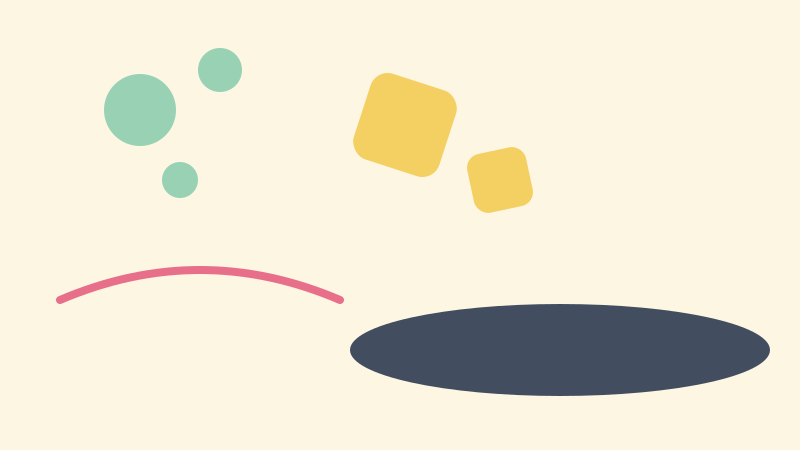 A scattered page and a low, heavy shape are both valid records. Let the layout follow the day, not a rule about neatness.
Reading your own pages after a month
Finally, resist the urge to judge each page on the day you make it. Put it away and look again after a month. Pages that felt messy in the moment often look brave, funny, or tender with a little distance. That shift in perspective is one of the quiet benefits of keeping a visual record at all. The monthly review is where art journaling changes from a nightly habit into a useful record, because single pages are noisy and collections are revealing. One scattered page could mean anything. Ten scattered pages, mostly on the same weekday, start to suggest a pattern worth noticing, even if you do not yet know what to do about it.
Make the review simple and short. Once a month, spread out the last four weeks of pages on a table or flip through them slowly, and ask yourself only three questions. First, what colours keep appearing, and on what kinds of days? Second, what shapes keep appearing — large or small, open or closed, high or low on the page? Third, what is missing: are there days, people, or activities that never appear, even though you know they happened? Write the answers in three or four sentences on a separate page or in your written journal. Those sentences are the bridge between visual journaling and ordinary reflection, and they are often more useful than any single page. If you keep a written mood journal as well, compare the two records for the same week. The written entries may explain a colour you kept using, and the visual pages may show a feeling the written entries smoothed over.
Do not use the review to grade yourself. The question is never “was this good art?” The question is “did this help me notice something?” If a page helped you notice that evenings feel calmer when you draw before bed, that is a useful page, even if the drawing itself is a grey blob. If a page helped you notice that you always reach for the same colour on tired days, that is useful too, because it gives you a quick visual shorthand for tiredness in future pages. Over time, that shorthand becomes a personal visual language: your own colours, shapes, and marks, understood by you, built slowly from your own days rather than copied from someone else’s style.
Common mistakes, and gentle fixes
Most beginners make the same few mistakes, and all of them have simple fixes. The first mistake is trying to draw realistically. If you spend twenty minutes trying to draw a recognisable house, tree, or face, you will run out of time and patience before you have recorded anything about the day. Fix it by returning to blocks, shapes, and colour. A house does not need to look like a house to stand for home; a square with a warm colour inside it can stand for home just as well, and it takes ten seconds. The second mistake is filling every inch of the page. Empty space is not unfinished; it is part of the composition, and it often stands for rest, quiet, or a part of the day you did not notice. Leave at least a little empty space on purpose, and notice how different a page feels with breathing room.
The third mistake is starting a new page every time you feel stuck, and abandoning the previous one half-finished. A half-finished page is not a failure, but a stack of abandoned starts can make the notebook feel like a record of giving up. Fix it by setting a timer and a clear stopping point before you begin, and by treating a page as finished when the timer ends, even if it looks incomplete. The fourth mistake is journaling only on good days, or only on bad days. A journal that records only one kind of day will mislead you when you review it, because it will suggest your life is more uniformly bright or dark than it actually is. Fix it by aiming for regularity rather than mood: a tiny page on an ordinary day is more useful, over a month, than a spectacular page on a single dramatic day.
The fifth mistake is hiding the journal because you are embarrassed by early pages. Privacy is perfectly reasonable, and you do not need to show your journal to anyone, but hiding it in a place you never open will end the habit. Fix it by choosing a private but visible spot, and by reminding yourself that early pages are supposed to look early. If you want inspiration without comparison, look at the gallery on this site for examples of simple gradient and shape artwork presented as a collection, and notice how much can be communicated with colour and arrangement alone, without any realistic drawing at all.
A weekly routine that survives real life
A routine that only works on perfect days will not survive a real week. Build yours around three sizes of page, and choose the size that fits the evening you actually have, not the evening you wish you had. A two-minute page is a single colour block and one word. A ten-minute page is one of the five recipes above, finished with a timer. A thirty-minute page, once or twice a week if you enjoy it, is a larger page that combines two recipes — for example, a collage background with a colour-block overlay and a sentence across it. All three sizes count. A week with five two-minute pages and one ten-minute page is a successful week, because the habit stayed alive and the record stayed continuous.
A simple weekly shape might look like this. On Monday, make a colour-block day, because Mondays often set a tone you will want to compare later. On Tuesday or Wednesday, try the one-image, one-sentence page, and keep the sentence specific. On Thursday, if the week has felt scattered, make a scribble map instead of forcing a neat page. On Friday, spend two minutes on a single shape for the week as a whole, not for the day. At the weekend, if you have time and energy, make a collage page from scraps collected during the week, or review the week’s pages and write three sentences about what you noticed. If you miss a day, do not try to catch up by making two pages the next day. Just make the next page, for the next day, and let the gap stay visible. Gaps are part of an honest record, and they tell you something about which evenings are hardest for journaling, which is useful information in itself.
Variations keep the practice alive when the routine starts to feel stale. Try a monochrome week, using only one colour plus black and white, and notice how much expression remains when colour choice is removed. Try a texture week, using only torn paper and glue, no drawing at all. Try a words-first week, writing the sentence before you add any colour, and notice whether the image changes. Try journaling outdoors for one page, using colours you can see around you rather than colours that match a feeling, and notice how the page changes when observation replaces introspection for a few minutes. If you want a prompt to start a page on a stuck evening, the daily journal prompts tool can give you a focused question, which you can answer in shape and colour instead of in words. The prompt is a starting point, not a test, and you are free to answer only part of it, or to let the page wander away from it entirely.
Frequently asked questions
Do I need to be able to draw? No. Art journaling, as described throughout this article, uses colour, shape, and arrangement, not realistic drawing skill. If you can make a mark, a block, or a scribble, you can make a journal page. Drawing skill may grow with practice, but it is not a entry requirement, and a page made by a skilled artist is not automatically a better journal page than a page made by a beginner.
What if I hate every page I make? That feeling is common in the first few weeks, and it usually softens when you review pages after a month rather than judging them on the night. Keep the pages anyway, keep them private, and keep the sessions short. If hatred of the pages is really hatred of the time pressure, shorten the session to two minutes. If it is really a dislike of a particular material, change the material. Do not throw away early pages in frustration; they are the baseline that will let you see change later, and they often look kinder with distance.
Should I journal every day? Every day is a good aspiration, but regularity matters more than a perfect streak. Five short pages a week, kept for three months, will teach you more than thirty pages in one enthusiastic week followed by nothing. If daily journaling feels like a chore, try three fixed days a week, and let other days be optional. A habit that survives is better than a habit that impresses for a week and then collapses.
Can I use photos or digital tools? Yes. A printed photo, a screenshot, a digital canvas, or a scanned page can all be part of an art journal, as long as the material is yours to use and you are not copying someone else’s work and claiming it as your own. Digital tools are especially useful for colour experiments, because you can try a palette, undo it, and try another in seconds. The mood art generator and the mood colour palette tool are both designed for that kind of low-stakes experimentation, and they can sit alongside a paper notebook without replacing it.
What should I do with finished notebooks? Keep them somewhere you can reach them, but not somewhere you will judge them every day. A shelf, a box, or a drawer you open for the monthly review is ideal. Label notebooks by date range, not by quality, so that future you can find a particular month without reopening old self-criticism. If a notebook contains anything you would not want another person to read, store it privately, and do not feel obliged to share it. A journal is a private record first, and a shareable object only if you choose to make it one.
 A longer journey is built from small pages. Keep the habit visible, short, and private, and let the collection do the talking over time.
A closing note, and a place to start tonight
Art journaling rewards patience more than talent. The first page will probably feel awkward. The tenth page will probably feel easier, not because you have become an artist, but because you have learned your own shorthand: which colours you reach for, which shapes feel natural, how much space you like to leave empty. By the fiftieth page, you will have a visual record of a season of your life that no written summary could quite replace, because it will show not only what happened, but how those days felt in colour, size, and arrangement. That record is worth building, one small page at a time, even — especially — when the pages are imperfect.
Tonight, if you have five minutes, try the simplest version. Take a small page, choose three colours, and draw the shape of your morning and the shape of your afternoon. Add one word, or one sentence, if you like, and stop when the timer ends. Put the page away without judging it. Tomorrow, do the same, or try a different recipe from this article. If you want a broader starting point, browse the blog for related guides, try a mood quiz to notice a starting point for the day, or open the mood art generator for a quick colour warm-up before you pick up a pen. The exact starting point matters less than the fact that you started, and that you gave yourself permission to make a page that is honest rather than beautiful.
This article is general information for creative reflection only. It is not medical advice, and it is not a substitute for professional help. If you are struggling, please reach out to a trusted person or a qualified professional in your area.