After a few weeks of journaling, it is natural to look for patterns. That curiosity is useful, as long as it stays simple. The most helpful patterns are usually the most ordinary ones: energy dips at a certain time of day, better evenings after movement, restless nights after late screens, or lifted moods after time with a particular person. You do not need complex charts to notice those patterns, and you do not need to explain every change.
A pattern, in this gentle sense, is not a law. It is a repeated observation that shows up often enough to be worth noticing, but loosely enough that exceptions are expected. If you feel flat most late afternoons, that is a pattern worth testing. If you felt flat one Tuesday after a difficult meeting, that is a day, not a pattern. Keeping that distinction is the whole skill. It protects you from turning a normal rough patch into a story about who you are, and it keeps journaling pleasant instead of turning it into detective work.
This article builds on the simple habit described in Mood Journaling for Beginners, where the goal is one honest sentence a day rather than a perfect record. Once you have a few weeks of those sentences, you can look back without pressure. You are not auditing yourself. You are reading your own notes the way you might read a travel diary: looking for places you return to, times of day you enjoy, and small conditions that seem to make a day easier or harder.

An abstract day cycle: energy and mood often rise and fall across the day, rather than staying flat.
What counts as a pattern, and what does not
A useful pattern has three qualities. First, it repeats. You see it on several different days, in different weeks, not just during one unusual week. Second, it is specific. “I feel bad” is too vague to act on, while “I often feel flat between four and six in the afternoon” points to a time window you can actually plan around. Third, it is small enough to test. A pattern that suggests one modest change, such as a short walk, an earlier wind-down, or a phone-free hour, is more useful than a pattern that demands a complete lifestyle overhaul.
What does not count is also worth naming. A single striking day does not count, even if it felt dramatic. A pattern you noticed only because you were looking for a reason to blame something does not count until it survives a second look. A pattern borrowed from someone else — a friend, a book, or a social media post — does not count until you check whether it actually shows up in your own notes. And a pattern that only appears when you squint, rearrange the evidence, and ignore all the exceptions is not a pattern at all. It is a story you are trying to make true.
That restraint matters because moods are influenced by many small things at once. Sleep, movement, food, weather, workload, conversations, news, hormones, pain, boredom, and anticipation can all play a part, and they rarely act one at a time. When you accept that messiness, you stop hunting for the one hidden cause of every low day. Instead, you start noticing a handful of conditions that, together, tend to make days a little easier. That is a kinder and more accurate way to read your own life.
It also helps to keep your language modest. Instead of writing “walking always fixes my mood,” try “a short walk often helps on flat afternoons.” Instead of “I am a morning person” or “I am not a morning person,” try “mornings tend to feel steadier when I start slowly.” Modest language leaves room for exceptions, and exceptions are not failures. They are information about context: the walk that helps after a desk-bound morning may not help after a physically tiring day, and that difference is itself useful to know.
The one-factor review: looking at one question at a time
A practical way to review is to sort entries by a single question at a time. For one review, look only at time of day. For the next, look only at sleep. For the next, look only at social contact. Reviewing one factor at a time prevents the common trap of seeing a pattern everywhere, where every bad day is blamed on the same single cause. Real life is messier than that, and most moods have several small contributors rather than one dramatic explanation.
Here is a simple way to run a one-factor review in about ten minutes. First, choose your factor before you open your journal, and write it at the top of the page: “This review is only about time of day.” Second, skim your last two or three weeks of entries and mark, in one colour or symbol, only the entries that mention that factor. Ignore everything else for now, even if another explanation jumps out at you. Third, write down what you actually see in two or three sentences, using counts where you can: “On six of the last ten weekdays, my afternoon note was flatter than my morning note.” Fourth, write down the exceptions in one sentence: “On the other four days, the afternoon felt fine, usually when I had a break outside.” That fourth step is what keeps the review honest.
If you use the Mood Journal on this site, your entries stay in your own browser, so a review like this is private and low pressure. You can read a week of entries, close the page, and think about it later without anyone else seeing your notes. The same approach works with a paper journal: use a coloured dot in the margin for the factor you are reviewing, and ignore the rest of the page for that pass.
Do not try to review every factor in one sitting. That is how a calm review turns into an overwhelming spreadsheet. Pick one factor per review, and let the other factors wait for their own turn. Over a month, you will have looked at time of day, sleep, movement, and social contact separately, and you will have a much clearer picture than if you had tried to untangle all four at once on a single evening.
Time of day: the easiest pattern to notice first
Time of day is a good first factor because it is already in every entry, even if you never wrote about it directly. Your journal entries have a time, or at least a morning, afternoon, or evening feel, and that is enough. Start by asking a very plain question: at which part of the day do my notes tend to sound most settled, and at which part do they tend to sound most flat or restless?
Many people discover a late-afternoon dip. That does not mean something is wrong with them. Late afternoon is often when the energy from the morning has faded, when work is still unfinished, and when the next pleasant thing — dinner, rest, a walk, a conversation — is still a little way off. Naming that window helps because you can plan a small, pleasant bridge across it: a glass of water, a stretch, a short step outside, a five-minute tidy, or a message to a friend. The point is not to eliminate the dip. The point is to make it a little less sharp, and a little less lonely.
Other people notice the opposite: mornings feel heavy, and evenings feel clearer. That, too, is useful information, and it does not need a grand explanation. It might simply mean that your mornings are crowded, rushed, or full of decisions, while your evenings have more breathing room. A practical response is to protect the first hour a little more — lay out clothes the night before, keep the first task small, or leave your phone in another room until breakfast is done — and then observe whether mornings feel any steadier over the next week. Again, you are testing a small change, not diagnosing a trait.
Try this worked example. Imagine your notes for a week read, in short form: Monday morning “steady, slow start,” Monday afternoon “flat, long meeting,” Tuesday morning “okay, slept late,” Tuesday afternoon “better after a walk,” Wednesday morning “rushed, forgot breakfast,” Wednesday afternoon “flat again,” Thursday morning “calm, early walk,” Thursday afternoon “fine, worked outside for a bit,” Friday morning “tired, busy week,” Friday afternoon “relieved, weekend coming.” A one-factor review of time of day would not try to explain Friday. It would simply note: afternoons felt flatter on the days without a break outside, and steadier on the days with one. That is enough to suggest a trial: a short outdoor break on two or three afternoons next week, and then a second look.
Sleep, movement, and social time: three gentle factors
After time of day, the next three factors most people find useful are sleep, movement, and social time. Keep each one simple. For sleep, you do not need a sleep tracker or a precise number of hours. A note like “slept well,” “slept late,” “woke often,” or “tired this morning” is enough for a pattern review. Look for whether mornings after restless nights tend to sound flatter, and whether that flatness tends to fade by the afternoon or linger all day. If it usually fades, that tells you something reassuring: a bad night does not necessarily ruin the whole day.
For movement, the same modesty applies. You are not measuring fitness. You are noticing whether days with a walk, a stretch, a bike ride, a dance in the kitchen, or any other movement you enjoy tend to have steadier notes than days spent almost entirely sitting. If you want a playful way to notice this, you can also try the Mood Quiz on a day you have moved and on a day you have not, and compare the snapshots it gives you — not as a verdict, but as a second, light-hearted observation to set beside your journal notes.
For social time, be specific about quality, not just quantity. A day with five rushed, tense conversations can feel very different from a day with one relaxed conversation with someone you trust. When you review social contact, look for the kind of contact that tends to appear in your better notes: a long walk with a friend, a calm phone call, a shared meal, a quiet hour working alongside someone else. Then look for the kind that tends to appear in your flatter notes: back-to-back meetings, difficult messages, or a whole day without speaking to anyone at all. The pattern, if there is one, is usually about the shape of the contact, not about being social in general.
Screens and evenings deserve their own small note, because they often interact with sleep. If your notes frequently mention scrolling late, bright light in bed, or work messages after dinner, and the next morning feels groggy, that is worth a small experiment rather than a rule. Try a phone-free hour before bed for a few nights, or charging your phone outside the bedroom, and see whether your morning notes change. If they do not change, you have learned something too: the grogginess may have another contributor, and you can move on without guilt.
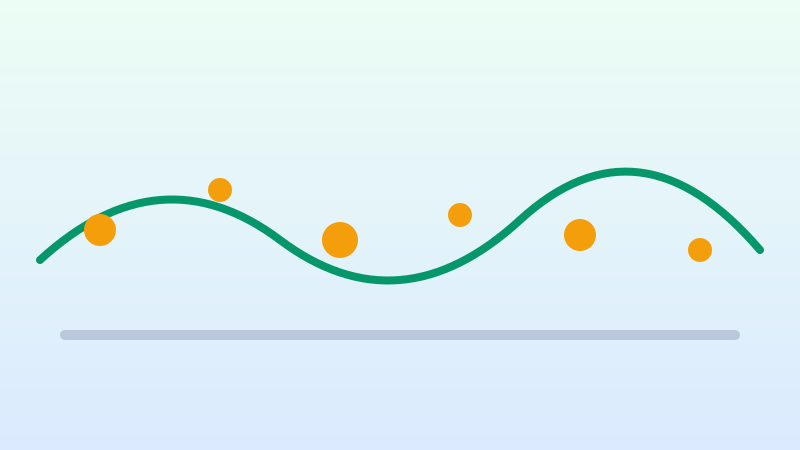
A weekly wave: a pattern is a shape that returns on several different days, not a single dramatic day.
A copyable seven-day review template
If a blank page makes reviewing feel hard, copy this template into your journal or a notebook. It is deliberately short. Long templates are rarely finished, and an unfinished template teaches you nothing.
Seven-day pattern review — one factor only
- Factor I am reviewing this week: ____ (for example, time of day, sleep, movement, or social time)
- Days I noticed it clearly: ____ / 7
- In one sentence, what did I see? ____
- The clearest exception was: ____
- One small thing I will try next week: ____
- How I will know whether it helped: ____ (for example, “my afternoon note sounds a little steadier on at least three days”)
Fill it in on a Sunday evening, or any quiet ten minutes at the end of the week. Keep the old templates together, even if some weeks are messy or half-finished. After a month, you will have four small reviews, and you can read them as a set. That set is much more trustworthy than any single week, because it shows you which observations survived across different weeks and which ones faded.
Here is a filled example, so you can see how plain the language should be:
- Factor: movement
- Days I noticed it clearly: 4 / 7
- What I saw: “On the four days I walked after lunch, my afternoon note was steadier than on the three days I stayed at my desk.”
- Clearest exception: “On Thursday I walked and still felt flat, because I was worried about a message I had not answered.”
- Small thing to try next week: “A ten-minute walk after lunch on Monday, Wednesday, and Friday.”
- How I will know whether it helped: “My afternoon notes on those days sound a little steadier, or at least less flat, than on the days without a walk.”
Notice what this example does not do. It does not claim that walking cures anything. It does not ignore Thursday. It does not turn a useful observation into a rule for life. It simply gives you a testable next step, and a way to judge it kindly.
If you like structure, you can pair this template with the prompts in Daily Reflection Prompts, which are designed to keep a daily note short and specific. A short, specific note is far easier to review than a long, vague one, because you can actually find the factor you are looking for when you read it back.
Small experiments: how to test a pattern without turning it into a verdict
It is equally important to notice what does not change. If a pattern appears once, it is a coincidence. If it appears several times across different weeks, it is worth testing with a small experiment: an earlier bedtime for a week, a short walk after lunch, or a phone-free hour in the evening. Treat the experiment as a trial, not a verdict. If it helps, keep it. If it does not, let it go without turning the result into a story about yourself.
A good experiment has four parts, and none of them needs to be complicated. First, one change only. If you change your bedtime, your walk, your meals, and your phone habits all in the same week, you will never know which change mattered, and you will probably feel exhausted by the effort. Second, a clear time limit. One week is usually enough for a first trial, and two weeks is plenty for most small changes. Third, a simple way to judge it. Use your existing journal notes, not a new scoring system: do the relevant notes sound a little steadier, a little lighter, or a little less flat on the trial days? Fourth, a kind exit. Decide in advance that you can stop the experiment without feeling guilty, and that stopping is a result, not a failure.
Here are three ready-made trials you can adapt, each with its own gentle judgement rule:
Trial one: the afternoon bridge. Change: a ten-minute break outside, or by a window, between three and five in the afternoon, on three days next week. Judge it by: do your late-afternoon notes on those days sound less flat than on the days without a break? Keep it if the answer is yes on at least two of the three days. Let it go, or try a different bridge, if not.
Trial two: the wind-down hour. Change: no work messages and no scrolling in the last hour before bed, on four nights next week. Replace that hour with something calm you already enjoy: reading, stretching, tidying, or a warm drink. Judge it by: do your morning notes on the following days sound a little more rested, or at least less groggy? Again, you are looking for a tendency, not a perfect result.
Trial three: one relaxed conversation. Change: one unhurried conversation, walk, or shared meal with someone you trust, on two days next week. Judge it by: do your evening notes on those days mention feeling a little more connected or settled? If yes, that tells you something useful about the shape of social time that helps you, and you can protect one such slot in the following week without trying to fill every day with social plans.
After each trial, write one paragraph, no longer. What did you try, what did you notice, and what will you do next? That paragraph becomes part of your pattern record, and it is far more useful than a week of detailed charts that you never look at again. Over time, those paragraphs form a personal guidebook: a short list of small things that tend to help you, a short list of things that did not, and a short list of conditions where you are still unsure. Uncertainty is a perfectly good entry in that guidebook.
Common mistakes, and gentle fixes for each
Mistake one: cherry-picking. You remember the three days that fit your theory and forget the four days that did not. Fix: always write down the exceptions in the same review. If the exceptions outnumber the examples, the pattern is not ready to act on yet, and that is fine.
Mistake two: one-cause thinking. Every low day gets blamed on the same thing: sleep, work, the weather, or a particular person. Fix: force yourself to name at least two possible contributors for any low day. “I slept late and I had three difficult meetings” is more honest than “I slept late, so of course the day was bad,” and it opens up more than one small, practical response.
Mistake three: reading too much into a dip. A low mood for a day or two is a normal part of life, not evidence of a condition, and a journal is not a diagnostic tool. Fix: use a waiting rule. If a dip lasts a day or two and then lifts, note it and move on. If a difficulty persists, interferes with daily life, or feels unsafe, the right next step is professional support, not deeper self-analysis. A good journal helps you notice when that step is needed, and gives you concrete examples to describe if you seek help.
Mistake four: comparing your pattern to someone else’s. Your friend thrives on early mornings, so you decide you must too, even though your own notes say otherwise. Fix: trust your own repeated observations over someone else’s routine. Routines are personal, and a routine that helps one person can feel punishing to another for perfectly ordinary reasons, such as different work hours, different caring responsibilities, or different energy rhythms.
Mistake five: turning a pattern into an identity. “I am a person who always crashes in the afternoon” sounds permanent, and permanent stories are hard to test. Fix: rewrite identity sentences as time-bound observations. “I have often felt flat in the late afternoon recently” leaves room for change, for exceptions, and for the small experiments described above. Language shapes how stuck a pattern feels, and modest language keeps the door open.
Mistake six: reviewing only when things feel bad. If you only open your journal on difficult days, your review will be biased towards difficulty, and you will miss the quieter good days that could teach you just as much. Fix: review on a fixed day each week, whatever kind of week it has been, and deliberately note at least one steadier day as well as one harder day. A balanced review is a more accurate review.
For more ideas on keeping a habit like this going without perfectionism, the article on How to Build a Mood Habit That Survives Real Life is a useful companion, because it focuses on triggers, tiny steps, and forgiving restarts rather than streaks. Pattern-spotting works best inside a habit you can actually maintain, not inside a habit you keep abandoning and restarting.
A ten-minute weekly routine you can actually keep
A routine that takes an hour will not survive a busy month. A routine that takes ten minutes might. Here is a weekly rhythm that many journal keepers find sustainable, and you can adapt the day and time to your own life.
Step one: skim (three minutes). Open your last seven days of entries and read them quickly, without editing or judging them. Notice any words that repeat: flat, steady, restless, relieved, tired, calm, rushed. Repetition is often the first clue to a pattern, even before you know which factor it belongs to.
Step two: pick one factor (one minute). Choose the factor that feels most alive this week. It might be the factor you already reviewed last week, if it still feels unresolved, or a new factor that jumped out during the skim. Write it down, and promise yourself that this review is only about that factor.
Step three: mark and summarise (four minutes). Mark the entries that mention that factor, write your two-sentence summary, and write your one-sentence exception. If you cannot find a summary, that is also a result: this factor may not be the important one this week, and you can try another next week.
Step four: choose one small next step (two minutes). Pick at most one trial for the coming week, using the experiment rules above. Write it as a concrete action with a day attached: “Walk after lunch on Monday and Wednesday,” not “walk more.” Concrete plans are easier to remember, easier to do, and easier to judge afterwards.
If you miss a week, do not try to review two weeks at once in a long catch-up session. Just review the most recent week and move on. A missed review is not a broken habit. It is a week when life was busy, and the next review will still be useful. That forgiving attitude is part of what makes pattern-spotting sustainable, and it is why the Mood Journal here is designed to be private and pressure-free: you are writing for yourself, not for an audience or a streak.
Variations for busy days, travel, and difficult weeks
Patterns do not disappear on busy days, but your ability to notice them does, and that is normal. On a very busy day, a one-line note is enough: “Busy, late lunch, flat afternoon, walk helped a little.” That single line still contains a time, a condition, and a small observation, and it will still be useful in a weekly review. You do not need a paragraph to spot a pattern later. You need a trace.
When you travel, your patterns will naturally shift, because your sleep, movement, meals, and social time all shift at once. Do not try to compare a travel week directly with a home week. Instead, note travel as a context in its own right: “Travel week: different sleep, more walking, less routine, notes steadier than expected.” That context prevents you from mistakenly concluding that something at home is broken, when in fact the whole setting was different.
During a difficult week — illness, bereavement, a work crisis, a family emergency — pattern-spotting should pause, or at least soften. You do not need to analyse a week when you are simply getting through it. A short note each day, or even a single word, is enough to keep the thread, and you can return to reviewing when life steadies. If difficulties persist or feel overwhelming, reaching out for professional support, or to a trusted person who can help you find it, is a more useful step than trying to chart your way out alone. A journal can support that conversation, but it does not replace it.
On good weeks, the same advice applies in reverse: do not try to freeze a good week into a permanent rule. A week that felt wonderful because of a holiday, a visit, or a project finishing is not a template for every week. Enjoy it, note what made it good in plain language, and let the next ordinary week be ordinary. Patterns are most useful when they help you make ordinary weeks a little steadier, not when they make you chase an exceptional week.

Balance, not perfection: a useful pattern leaves room for exceptions and for ordinary variation.
Frequently asked questions
How many weeks do I need before I can spot a pattern? Two to three weeks of short, regular notes is usually enough to notice a first, tentative pattern, especially for time of day. Four to six weeks gives you a much more trustworthy picture, because you can see whether the same observation survives across different kinds of weeks. There is no prize for spotting a pattern quickly, and a pattern noticed slowly is often a pattern noticed well.
What if I cannot find any pattern at all? That is a perfectly normal result, and it may mean several things. Your notes may be too vague to review — try adding one concrete detail per entry, such as a time, a place, or an activity. Your life may be fairly steady right now, so there is no strong pattern to find. Or the important factor may be one you have not reviewed yet. Try a different factor next week, and keep the language simple. Not finding a pattern is not a failure of journaling.
Should I track numbers, scores, or charts? You can, if you enjoy them, but you do not need to. Many people find that numbers make journaling feel like homework, and then they stop journaling altogether. A few words per day, reviewed with the one-factor method, will usually teach you more than a detailed spreadsheet you never open. If you do like numbers, keep them to one simple scale — for example, energy from one to five — and review it alongside your words, not instead of them.
What if a pattern worries me? First, check whether it is really a pattern: does it repeat across weeks, and does it survive the exceptions test? Second, consider whether it is something you can test with a small, practical change. Third, if a low mood, anxiety, or other difficulty persists, interferes with your daily life, or feels unsafe, seek professional support rather than trying to analyse it further on your own. Bringing your journal notes to that conversation can help you describe what you have noticed in concrete terms, but the journal itself is not a diagnosis.
Can I use creative work to spot patterns? Yes, and for some people it works better than words alone. If you make a small artwork each day, you can review a week of artworks and notice recurring colours, shapes, or compositions, just as you would notice recurring words. The Mood Art Generator and the examples in the Gallery can give you a starting point for that kind of visual review, and the colour ideas in Colour Psychology and Mood can help you describe what you see without over-claiming what a colour means.
How often should I review? Once a week is plenty for most people, and once a fortnight is fine if life is busy. Reviewing every day tends to create noise, because you start reacting to each day’s note as if it were a verdict. A weekly rhythm gives patterns time to show up, and gives you time to live between reviews. The goal is a habit that helps you live, not a habit that replaces living.
Used gently, pattern-spotting is a form of self-knowledge. It turns “I always feel bad” into “I often feel flat in the late afternoon, and a short break helps.” That second sentence is smaller, kinder, and far more useful — and it is exactly the kind of insight a simple daily record is meant to provide. Keep your reviews short, your language modest, your experiments small, and your exceptions visible, and the patterns that matter will show themselves without you having to chase them.
This article is general information for creative reflection only. It is not medical advice, diagnosis, or treatment, and it is not a substitute for professional help. If you are experiencing persistent low mood, anxiety, or other difficulties that interfere with daily life or feel unsafe, please reach out to a trusted person or a qualified professional in your area.